
When Enterprise Architecture Goes Sideways: 4 Anti-patterns and Fixes
Practical warning signs, metrics, and governance moves you can use this quarter.

A team I worked with did everything “right” on paper. We had a clear business goal, a tight deadline, and a talented group of engineers who could ship fast. And we did. The first release landed quickly, stakeholders were happy, and the roadmap looked achievable.
Then the second phase arrived.
Suddenly, every sprint started with a long meeting about “the right” database. Then another about messaging. Then another about observability tools. Decisions dragged because too many people needed to agree, but nobody owned the final call. To buy time, we ran more spikes. To reduce risk, we added more tools. To “future-proof” analytics, we copied more data into more places.
A few months later, the delivery pace slowed to a crawl. The architecture wasn’t broken because the team lacked skill. It broke because a handful of well-meant choices multiplied across the enterprise: decision-making drifted, data spread without ownership, integration layers became overloaded, and tooling started running the teams instead of supporting them.
In this article, you’ll learn four enterprise architecture anti-patterns, how to spot them early using simple signals and metrics, and the practical steps to fix them before they become expensive habits.
What is an anti-pattern in enterprise architecture?
Enterprise architecture is full of “best practice” advice. The catch is that the same idea can be brilliant in one context and painful in another. That’s where patterns and anti-patterns matter.
Patterns vs anti-patterns (plain-English definitions)
Pattern: a repeatable approach that solves a known problem in a specific context. It has trade-offs, but the benefits are worth it when the conditions fit.
Anti-pattern: something that looks smart at the start, often because it feels efficient or “safe”, but it creates recurring pain once the organisation scales.
Quick tell: if teams keep saying “we’ll fix it later”, you’re probably already in anti-pattern territory. “Later” becomes the roadmap, and the architecture starts accruing interest.
A useful mindset shift is this: an anti-pattern is rarely stupidity. It’s usually speed, fear, or unclear ownership showing up as “design”.
A grounded definition of “architecture”
To keep this practical (and avoid word games), anchor on a simple, standards-based view:
Architecture describes the fundamental elements of a system, the relationships between those elements, the environment in which the system operates, and the guiding principles that shape how the system is designed and how it evolves over time.
That last part matters. Architecture is not just a diagram of what exists today. It’s also the set of rules that decide how change happens tomorrow. When those rules are missing or messy, anti-patterns spread fast.
The four layers where EA anti-patterns show up
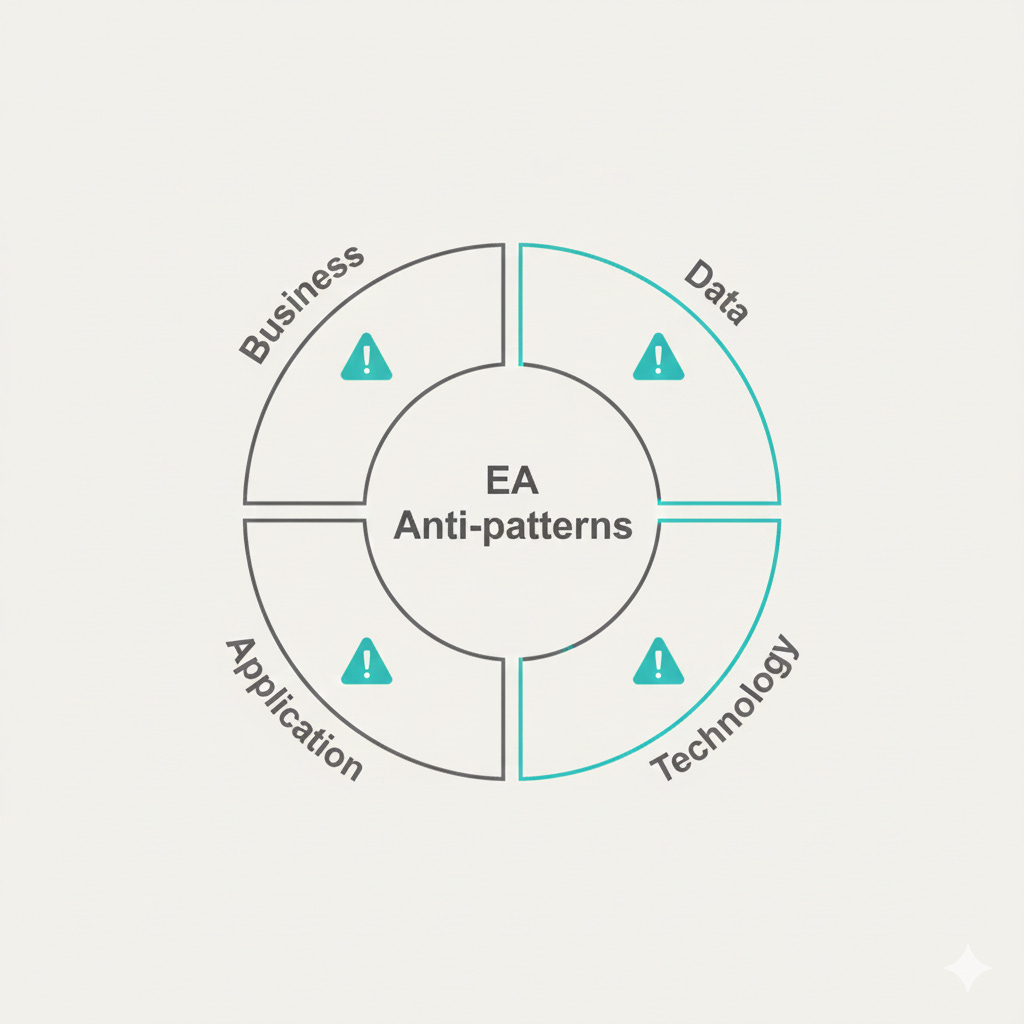
Enterprise architecture anti-patterns don’t appear in one place. They spread across layers, and each layer has its own style of failure. If you only look at apps, you’ll miss the business decision problem. If you only look at tooling, you’ll miss the data lifecycle problem.
A simple lens: Business, Data, Application, Technology
Business: decision-making, priorities, operating model
This is where anti-patterns show up as slow decisions, unclear ownership, competing agendas, and “everyone approves, nobody owns”.
Data: quality, retention, governance, value
This is where anti-patterns look like uncontrolled replication, mystery datasets, poor classification, and growing risk wrapped in “just in case”.
Application: service boundaries, integration, coupling
This is where anti-patterns appear as messy service responsibilities, overloaded integration layers, brittle dependencies, and change that breaks unrelated teams.
Technology: platform, tooling, operational practices
This is where anti-patterns show up as tool sprawl, inconsistent environments, fragile automation, and operational effort that keeps rising even when “everything is automated”.
Same enterprise, different layer, different failure mode.
Anti-pattern 1: Design by committee
“Design by committee” usually starts with good intent: get the right people in the room, reduce risk, and avoid bad calls. The problem is what happens next. Decision-making turns into a recurring meeting series, and architecture becomes a negotiation instead of a discipline.
What it looks like in real teams
Endless architecture meetings that end with “let’s do another spike”
No clear decision owner
Everyone can block, nobody can close
You’ll often see a team shipping early, then stalling as complexity rises. The meeting load goes up while delivery slows down.
Early warning signs
Too many decision-makers in one room
Repeated debates on storage, messaging, frameworks
Increasing tech debt and refactoring churn
Delivery dates slip because decisions arrive late
A classic symptom is “decision drift”: the team starts coding without a decision, then later discovers a half-written guideline somewhere and tries to retrofit it.
Metrics you can track (even without fancy tooling)
You don’t need a big governance platform to spot this. Track a few simple indicators:
Number of architecture meetings per decision
Time from “decision needed” to “decision published”
Count of spikes raised due to decision ambiguity
Rework rate: stories reopened due to architectural changes
If those numbers trend up together, you’re paying a “decision tax” every sprint.
Fix: a lightweight decision system, not a heavyweight committee
The goal isn’t less collaboration. It’s clearer ownership and faster closure.
Define decision roles
One accountable owner for the decision, plus a small review group. Keep the decision-making circle tight; widen the feedback circle instead.
Standardise decisions with ADRs and a simple lifecycle
Use a consistent format and statuses such as proposed, accepted, superseded, rejected. The point is clarity: what we decided, why, what we didn’t choose, and when it changes.
Set a “decision SLA” for common choices
Example: “Most decisions close within 5 working days.” If it can’t close, force the next question: what information is missing and who owns getting it?
Publish a small set of viewpoints and tools
Pick the minimum that keeps teams aligned (for example C4/UML, draw.io/PlantUML, and one shared repository for diagrams and ADRs). Consistency beats perfection.
Two “hidden traps” to call out (quick and human)
Ivory tower architect: decisions appear, but nobody can ask questions. The team learns by guessing, and gaps turn into rework.
Architect plays golf: the architect leaves, and the team inherits a design they can’t evolve. The architecture becomes a relic, not a living guide.
Design by committee is a process smell. Fix the decision system, and the architecture starts behaving like a product again: owned, iterated, and measurable.
Anti-pattern 2: Bad data virus
Bad data rarely arrives with a bang. It spreads quietly. One “temporary” dataset becomes a permanent table. One export becomes a pipeline. One replica becomes a lake. Then suddenly you’re paying for data nobody trusts, nobody owns, and nobody can confidently delete.
What it looks like
Old, unused data gets replicated into new systems (replicas, lakes, analytics, AI)
Nobody can explain why certain datasets exist
Storage and risk grow together
The giveaway is when the enterprise keeps copying the same uncertainty into new platforms. The data looks more “modern”, but the confusion stays.
Why it happens
Fear of deleting data
Weak classification and ownership
Retention handled as an afterthought
Most teams don’t choose this deliberately. They’re trying to stay safe, keep options open, and avoid being blamed for deleting “something important”. Over time, “safe” becomes expensive.
Early warning signs
Low usage datasets with high storage cost
Unclear sensitivity classification
“We might need it later” becomes the default policy
If your data discussions are mostly about where to store it, not why it exists and who uses it, you’re already slipping.
Metrics to watch
You can make this measurable without turning it into a massive governance program:
Data access frequency (reads/writes per dataset)
Age distribution of data (how much is stale)
Percentage classified vs unclassified
Audit findings tied to data governance gaps
A simple starting point: rank your top datasets by cost, then overlay usage. The scary ones rise to the top fast.
Fix: treat data like a product with a lifecycle
The cure is less about new platforms and more about basic hygiene and accountability.
Run a data assessment (what exists, who owns it, who uses it)
Build a lightweight inventory: dataset name, owner, purpose, consumers, retention rule, and sensitivity level.
Classify data and align retention policies
Classify by value and risk, then set retention based on actual need (not fear). If you can’t explain the purpose, it’s not ready to spread.
Introduce deletion and archiving automation
Manual deletion rarely happens. Automate it with clear approvals, logging, and safety rails (archive first, delete after a defined window).
Tie dark data reduction to security outcomes
Less unknown data means fewer places sensitive information can hide, leak, or get copied into tools that were never designed to protect it. Smaller attack surface, cleaner audits, and less time arguing about what’s safe to share.
Bad data virus is the anti-pattern where “just in case” becomes the default architecture. Fix it by making data ownership, lifecycle, and retention normal operational work, like patching or access reviews.
Anti-pattern 3: Swiss Army knife integration
This one is sneaky because it often starts as a rescue mission. Teams move to event-driven patterns to reduce tight coupling, then the integration layer slowly becomes the place where “everything gets solved”. Over time, the broker turns into a Swiss Army knife: handy, overloaded, and impossible to hand to someone new without cutting yourself.
What it looks like in 2025 systems
The message broker or integration layer starts doing everything: routing, transforms, auth logic, orchestration, even business rules
A small “core team” becomes a bottleneck because only they understand the glue
It’s the modern version of the old “mega-database with magic stored procedures”. Different tool, same problem: logic hidden in a place that’s hard to test, hard to version, and hard to reason about.
Symptoms you’ll hear out loud
“We can’t change that, it might break other flows”
“It’s all in the broker rules”
“We need the one person who built it”
When those phrases show up, your integration layer has stopped being plumbing and started being a shadow application.
Metrics that reveal it
Growth in message types and transformations
Incidents tied to broker changes
Mean time to recover when messaging breaks
Percentage of business rules living outside services
A practical check: if a broker change needs the same level of analysis and testing as a service release, you’ve turned the broker into a product without admitting it.
Fix: move intelligence to services, keep pipes simple
The goal isn’t “no integration logic”. The goal is to keep the broker focused on transport and coordination, while services own the domain rules.
Reduce transformation logic in the broker
Minimise mapping scripts and embedded decision trees. If transformations must exist, make them simple, visible, and versioned like code.
Standardise contracts and versioning
Define event/message schemas, version them explicitly, and treat compatibility as a first-class concern.
Push business rules back into domain services (“smart endpoints”)
Keep decision-making close to the domain. Services should validate, decide, and act. The integration layer should pass messages, not “think”.
Add tracing and clear observability for message flows
Make every hop visible: correlation IDs, distributed tracing, and meaningful metrics (latency, failures, retries). If you can’t see the flow end-to-end, you can’t manage the risk.
Swiss Army knife integration feels efficient until the day you need to change it quickly. Then it becomes a single point of confusion, delay, and fragility. Keep pipes simple, and your teams get their autonomy back.
Anti-pattern 4: Operational over-tooling
Tools are meant to remove friction. Operational over-tooling does the opposite: it adds layers of dashboards, scanners, pipelines, and platforms until teams spend more time managing the toolchain than improving the product. The result is a noisy, expensive system that still wakes people up at 2am.
What it looks like
Tool sprawl: overlapping CI/CD, logging, monitoring, security scanners, dashboards
Teams spend more time operating tools than shipping outcomes
Automation exists, but the on-call pain stays
A clear sign is when “keeping the platform running” becomes a bigger job than building the thing the platform exists to support.
Common causes
Tool adoption driven by trends or CV-building
“DevOps equals automation” thinking
No exit plan once a tool is in
A lot of over-tooling is fear in disguise: fear of manual work, fear of incidents, fear of being seen as behind. So the response is “add another tool”.
Metrics to track
Tool count per category (CI, observability, security, IaC)
Feature usage rate (how much of the tool you actually use)
Integration effort per tool (time to onboard, maintain, upgrade)
Training/support load per quarter
If the tool count rises while incident rates and lead time don’t improve, you’re buying complexity, not reliability.
Fix: governance that helps teams move faster
This isn’t about banning tools. It’s about making tool decisions deliberate, visible, and reversible.
Run a tooling audit and create a simple inventory
List the tools, licences, owners, purpose, cost, and which teams rely on them. You can’t fix sprawl if nobody can see it.
Set tool adoption criteria
For every new tool: define the problem, compare options, write a decision record, run a trial, and set a rollout plan (including success measures).
Standardise where it pays off, allow exceptions with an ADR
Standardisation reduces cognitive load and onboarding time. Exceptions are fine, but they should be explicit and justified so they don’t quietly become the new default.
Use Well-Architected style anti-pattern checks as a review prompt
Treat reviews as a way to catch operational smells early: duplicated tooling, noisy alerting, brittle pipelines, and automation that creates work instead of removing it.
Operational over-tooling is the moment your tooling becomes the product. The fix is simple governance that keeps choice intentional and keeps teams focused on outcomes, not operating a maze.
A practical cadence to prevent anti-patterns (without slowing delivery)
Most anti-patterns don’t arrive as a single bad decision. They grow when teams are busy, deadlines are real, and “we’ll clean it up later” feels like the only way to move. The fix isn’t heavier governance. It’s a repeatable cadence that keeps decisions small, visible, and testable.
A six-step loop your teams can repeat
Think of this as an architecture “heartbeat” you can run every iteration or every PI, depending on your scale:
Gather stakeholder inputs
Short, purposeful conversations: product, delivery, ops, security, data, and the teams building the work. Capture what success looks like and what pain must be avoided.
Identify ASRs, constraints, risks, assumptions
Make the hidden stuff explicit. What must be true for this to work? What can’t change? What are we betting on? What could hurt customers or delivery?
Choose principles and tactics
Agree on a few guiding rules (security-by-design, minimise coupling, prefer managed services, etc.) and the tactics that support them.
Compare options, make trade-offs, publish ADRs
Don’t debate forever. Compare a small set of options, state the trade-offs, and publish the decision so teams can move with confidence.
Create the few diagrams people will read
Resist the urge to document everything. Create the minimum set that helps teams build, operate, and change safely.
Build a delivery roadmap, then iterate
Translate architecture into delivery slices: sequencing, dependencies, risks, and checkpoints. Then revisit as reality changes (because it will).
This loop keeps architecture close to delivery. It also makes anti-patterns easier to spot early, because you’re repeatedly surfacing decisions, ownership, and trade-offs.
“Fitness functions” as your guardrails
Fitness functions are simple measurable checks that protect the architecture over time. They reduce arguments because the system tells you when you’re drifting.
Keep the list short and tied to outcomes, for example:
Latency (end-to-end response time targets)
Cost (unit cost per transaction or per customer)
Recovery time (RTO/RPO, or time-to-restore for key services)
Security events (unauthorised access attempts, critical vulnerabilities, failed controls)
Data retention compliance (datasets with owners, classification, and enforced retention)
If a change improves features but fails the fitness functions, it’s a signal to pause, adjust, and avoid baking in the next anti-pattern.
Simple checklist you can run this week
Anti-patterns rarely start as disasters. They start as shortcuts that quietly become habits. The earlier you notice them, the cheaper they are to fix.
Here’s a quick recap of the four anti-patterns we covered:
Design by committee: decisions stall, spikes multiply, and delivery slows because nobody owns the call.
Bad data virus: unused data spreads into replicas, lakes, analytics, and AI, while cost and risk climb together.
Swiss Army knife integration: the broker/integration layer absorbs routing, transforms, and business rules until one team becomes the bottleneck.
Operational over-tooling: tool sprawl grows, cognitive load rises, and on-call pain stays even when “everything is automated”.
If you want a practical next step, run this mini-checklist in your next architecture sync:
Do we have a clear decision owner for each major choice?
Are we capturing decisions in a consistent way (even a lightweight ADR)?
Which datasets exist “just in case”, and who owns them?
Is our integration layer doing transport, or is it doing business logic?
Which tools do we pay for but barely use, and what problem are they meant to solve?
If you comment your context (team size, delivery model, and where you’re feeling the most pain), I’ll suggest the top two anti-patterns to tackle first and a small, realistic plan to unwind them without slowing delivery.